The Greater Hyderabad Municipal Corporation (GHMC) has partnered with Indian Institute of Technology Kharagpur and All India Institute of Medical Sciences to launch a cutting-edge water quality monitoring initiative aimed at improving public health and environmental safety in Hyderabad.
GHMC Announces Landmark Partnership to Launch Advanced Water Quality Monitoring Initiative in Hyderabad
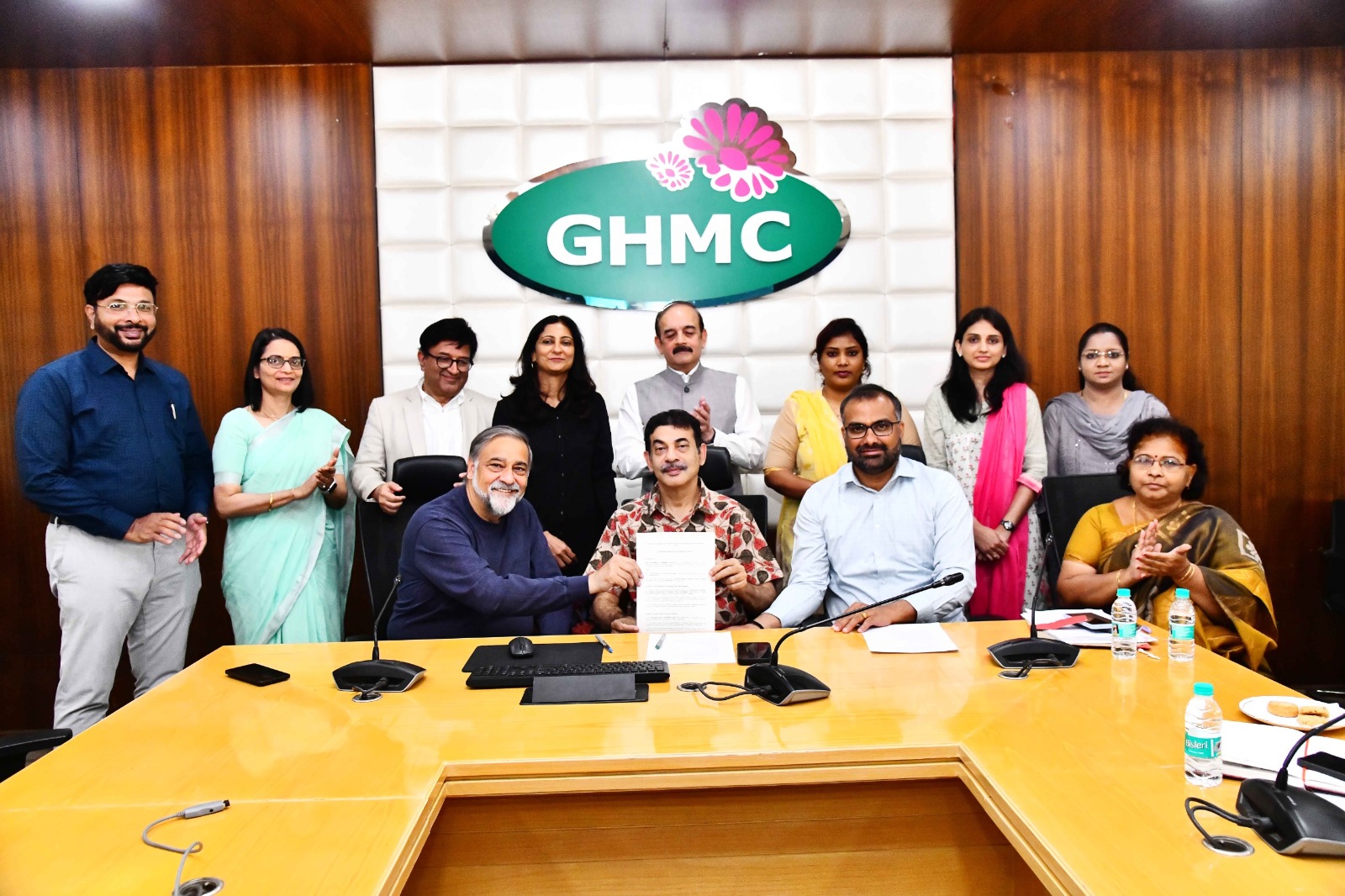
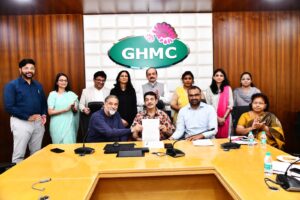
The Greater Hyderabad Municipal Corporation (GHMC), in the presence of Spl. Chief Secretary, MA&UD, Sri. Jayesh Ranjan, IAS, today announced a landmark Memorandum of Understanding (MoU) with the Indian Institute of Technology Kharagpur (IIT Kharagpur) and the All India Institute of Medical Sciences (AIIMS), New Delhi, to launch one of India’s most ambitious and technologically advanced water quality monitoring initiatives.
The project, which is expected to commence in the third quarter of this year, will establish a next-generation water surveillance and early-warning system for Hyderabad, combining advanced scientific research, artificial intelligence, and real-time environmental monitoring to protect public health and strengthen long-term water governance across Telangana.
The initiative is being supported through collaborative partnerships involving industry, research institutions, and technology partners, with additional participation expected in the coming months. The collaboration brings together some of India’s leading scientific and academic institutions to work on advanced AI-driven spectral analysis technologies in collaboration with engineers and researchers from premier national institutions including IIT Madras and AIIMS Delhi.
A New Approach to Water Surveillance:
Unlike conventional water testing systems, which rely on slow laboratory workflows and test for only a limited set of known contaminants, the proposed platform uses advanced nonthermal plasma spectroscopy and artificial intelligence to analyze the complete optical signature of a sample. This enables rapid identification of a broad range of contaminants, including heavy metals, industrial chemicals, microbial indicators, and emerging pollutants, while also identifying anomalous patterns that may signal previously unrecognized risks.
The technology has already demonstrated the ability to detect contaminants at parts-perbillion levels with accuracy comparable to or exceeding gold-standard laboratory methods. It is capable of processing large numbers of samples rapidly while requiring significantly less sample preparation and infrastructure than traditional mass spectrometry systems.
As part of this initiative, water samples collected from across the city will be analyzed at the proposed facility. The analytical results will be integrated into a centralized platform for realtime analysis, pattern recognition, and rapid alert generation to support faster intervention and decision-making by relevant authorities.
Over the initial 12-month pilot phase, the programme is expected to process more than 25,000 water samples across the Hyderabad metropolitan region, generating approximately 1.9 million individual analytical data points covering chemical, elemental, and microbiological parameters.
The School of Water Resources at IIT Kharagpur will play a central role in guiding the scientific and remediation strategy of the initiative. IIT Kharagpur’s faculty bring extensive expertise in water quality management, contaminant transport modeling, hydrology, urban water systems, wastewater treatment, and environmental engineering. The institute has led major national initiatives related to groundwater management, river systems, and real-time water monitoring.
In addition to helping design scientifically robust sampling and monitoring frameworks, IIT Kharagpur will support the Government of Telangana in identifying contamination pathways, prioritizing interventions, modeling infrastructure vulnerabilities, and developing long-term remediation strategies. The partnership is also expected to drive major scientific research and publications in water quality, environmental intelligence, and public-health analytics. The operational coordination of the initiative will be undertaken by the Metropolitan Surveillance Unit (MSU), Hyderabad. The MSU, along with GHMC officials, will coordinate sample collection workflows, field operations, inter-agency integration, data consolidation, and stakeholder coordination across participating institutions and government departments to ensure effective implementation and timely response mechanisms.
Sri. Jayesh Ranjan, IAS, Special Chief Secretary, Department of Municipal Administration & Urban Development (MA&UD), said:
“Telangana has consistently sought to position itself at the forefront of technology-led governance and public welfare. We are excited to partner with some of India’s finest scientific institutions and innovators to build a model for water safety and environmental intelligence that can ultimately benefit not only Telangana, but people across India and the world. This initiative represents a major step toward proactive, data-driven public-health protection.”
Prof. Suman Chakraborty, Director, IIT Kharagpur, said:
“IIT Kharagpur is very excited to collaborate with the Government of Telangana on this important initiative. Our faculty and researchers have deep expertise in water systems, environmental engineering, and contaminant modeling, and we look forward to contributing scientific rigor, research leadership, and practical solutions to address this critical challenge.”
The Hyderabad initiative is expected to become a model for broader deployment across Telangana following successful completion of the pilot phase. Long term, the Government of Telangana envisions building a statewide environmental intelligence framework capable of continuously monitoring water systems, identifying risks earlier, guiding infrastructure investments, and strengthening public-health resilience.
The programme also aligns with several national and international priorities, including the Jal Jeevan Mission, preventive public-health initiatives, and United Nations Sustainable Development Goals related to clean water, health, and sustainable urban development.
As part of the MoU framework, all environmental and analytical data generated through the initiative will be protected under the highest standards of cybersecurity, privacy, and data governance. Access to operational data, monitoring outputs, and system intelligence will be shared exclusively with authorized Government of Telangana agencies and designated institutional partners for public-health and water-management purposes.Hedding and keywords