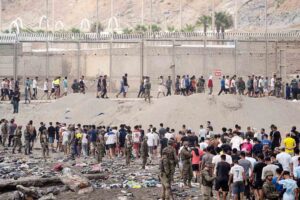

 Ceuta, Spain: Spain is facing one of its largest migration surges in recent years after authorities estimated that around 60,000 migrants entered the Spanish enclave of Ceuta from neighboring Morocco within just 24 hours. Thousands crossed by swimming around border barriers or entering through land routes, overwhelming local reception facilities and prompting an emergency response from Spanish and European authorities.
Ceuta, together with Melilla, is one of Spain’s two autonomous territories on the northern coast of Africa and forms part of the European Union. Its unique location has long made it a focal point for irregular migration into Europe.
Spanish officials said the sudden influx appears to have been driven by a combination of economic hardship in Morocco, misinformation spread through social media, and confusion over a recent Spanish Supreme Court ruling involving migrants arriving by sea. Authorities say criminal smuggling networks exploited these rumors to encourage people to attempt the dangerous crossing.
The mass crossing created a humanitarian and security challenge, with temporary reception centers in Ceuta struggling to accommodate the large number of arrivals. Spanish Prime Minister Pedro Sánchez described the situation as a serious challenge to Spain’s territorial integrity and pledged to restore border control.
The journey proved deadly for many. Reports indicate that dozens of migrants lost their lives while attempting to swim across the sea separating Morocco from Ceuta, highlighting the dangers of irregular migration.
 Spanish authorities, working with Moroccan officials, began processing the arrivals immediately. According to officials, most migrants voluntarily returned to Morocco within a short period, while others were processed under Spanish immigration procedures. Authorities emphasized that entering Ceuta does not automatically provide access to mainland Spain or the rest of the European Union.
The incident has sparked debate across Europe over migration management, border security, and the need for stronger cooperation between Spain, Morocco, and the European Union to address the root causes of irregular migration while ensuring humanitarian protections.